Meat Thermometers for BBQs: Choosing a Probe and Taking a Useful Reading
A food thermometer helps answer a question that a browned surface cannot: what temperature has the inside reached? For a barbecue, a handheld instant-read probe is useful for checking individual pieces before serving. The reading still depends on where you place the sensor, allowing it to settle and applying the correct food-safety guidance.
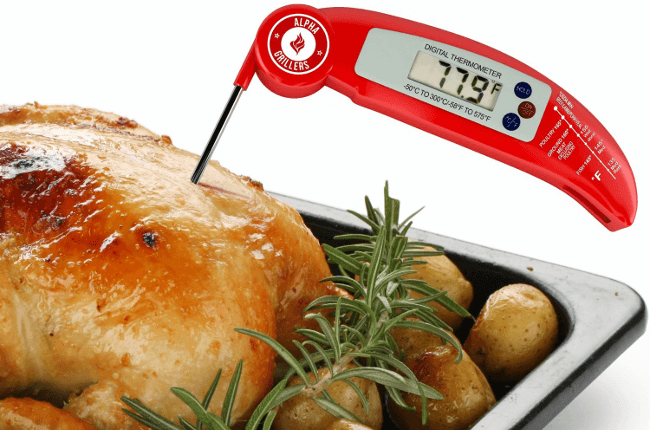
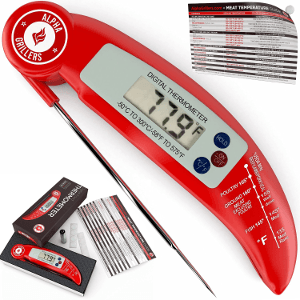
This article began with an Alpha Grillers folding thermometer in 2016. Its photographs remain as historical illustrations. The advice below was checked in October 2026 and separates that older product from current examples. We have not conducted a comparative product test, and no thermometer guarantees safe food by itself.
Instant-read, leave-in or infrared?
An instant-read probe is held in the food long enough to obtain a stable reading, then removed. A folding design can be convenient for a cook who checks several pieces in succession. “Instant” is a product category, not an instruction to accept the first number that flashes on the screen.
A leave-in probe system is designed to monitor food during cooking, subject to its stated probe, cable and transmitter limits. It can suit a long cook, but the correct placement and heat limits still matter. Do not leave an ordinary folding thermometer inside a barbecue or oven unless its instructions explicitly permit that use.
An infrared thermometer measures a surface. It cannot establish the temperature at the centre of a burger or chicken portion. The Food Standards Agency’s probe guidance distinguishes surface measurement from core-temperature checking.
Take the reading where it matters
The USDA’s food-thermometer guide recommends checking the thickest part, away from bone, fat and gristle. For thin foods, approach from the side so the sensing area reaches the centre. Check each piece; a large or irregular item needs checks in several places.
- Check the instrument: select the intended °C or °F scale and read its instructions for sensor position and minimum insertion depth.
- Use a clean probe: prevent a probe that touched raw or partly cooked food from contaminating cooked food.
- Position it deliberately: keep the sensor in the food, not against the hot cooking grate. Take care around flames, steam and hot metal.
- Wait for a stable reading: compare it with the guidance for that food, including any required holding or resting time.
- Recheck where necessary: if it is not ready, continue cooking and check again with a cleaned probe.
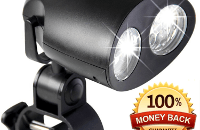
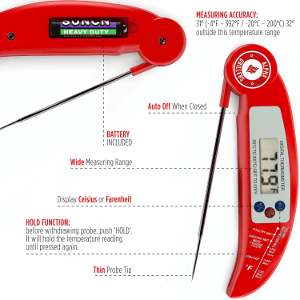
A “hold” button can make the display easier to read after withdrawal, but it only freezes the measurement you took. It cannot correct a poorly positioned probe. Arrange enough light to see both the food and the probe; our older grill-light article illustrates the task-lighting idea, although any current light’s mounting and heat limits need checking separately.
Use the right temperature guidance for your country and food
For readers in England, Wales and Northern Ireland, the Food Standards Agency’s cooking guidance specifies 70°C for two minutes at the centre, or an equivalent combination such as 75°C for 30 seconds. The time is part of the instruction: briefly touching the displayed temperature is not the same as satisfying the combination. Follow the guidance for the particular food and its cooking instructions.
For US readers, the USDA minimum-temperature chart lists poultry at 165°F, ground meats at 160°F, and beef, pork, veal and lamb steaks, chops and roasts at 145°F followed by at least three minutes’ rest. Ground poultry belongs with poultry, not the lower ground-meat value. These are distinct food categories, not a scale for choosing a burger’s preferred colour.
Do not combine a temperature from one regional chart with a time from another, or use a rare-steak preference chart as a general food-safety table. Keep the appropriate official guidance available when cooking. Storage, separation of raw and cooked food, clean utensils and prompt handling after cooking remain necessary alongside temperature checks.
Clean the probe properly between uses
A quick wipe with a damp cloth is not a complete cleaning routine. Remove food residue and use the cleaning and, where required, disinfection method approved for the instrument and food-contact probe. FSA guidance stresses cleaning the thermometer after each use to avoid cross-contamination.
Keep electrical housings and seals within their stated water-resistance limits. A rating on a current model cannot be transferred to an older thermometer bearing the same brand. Do not put a thermometer in a dishwasher or immerse it unless its own instructions allow that treatment.
For example, the Thermapen ONE instructions specify antibacterial probe wipes and warn that isopropyl alcohol and other solvents may damage its case and screen. This illustrates why generic cleaning advice should not override a particular manufacturer’s instructions.
The original Alpha Grillers and current documented examples
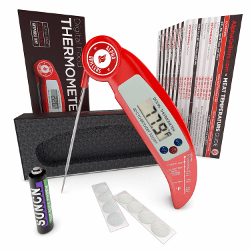
The older page described a red Alpha Grillers thermometer, a folding probe and a supplied temperature card. Those details remain useful context for readers who already own it, but the original listing alone does not establish its current support, cleaning rating or performance specification.
The current Alpha Grillers single-battery product, identified by UPC 841507117866, is advertised with a backlit display, recalibration facility, a one-to-two-second response and IP67 water resistance. Those are the manufacturer’s claims for that listed version, not measurements made by this site or an upgrade to the old photographed unit.
As another documented option, the UK Thermapen ONE lists a thermocouple sensor, rotating display and IP67 protection. Its stated accuracy is ±0.3°C within −19.9 to 119.9°C; the accuracy specification changes outside that interval. The advertised one-second reading is a manufacturer specification, not a result from a Garden Gadget Zone test.
Neither example is declared the “best”. Compare the functions you will use, local warranty/service arrangements and the exact package. Prices and stock change, so this guide does not preserve an old offer as a current bargain.
A practical buying and ownership checklist
- Readable display: can you see the number and unit while holding the probe in position, including in poor light?
- Suitable sensing area: will the probe work with thin burgers as well as the larger joints you cook?
- Documented accuracy: check the relevant temperature interval, not just how many decimal places appear on the display.
- Cleaning instructions: make sure a workable food-hygiene routine is compatible with the probe and housing.
- Battery and support: check replacement batteries, clear instructions and a route to servicing or replacement if readings become unreliable.
Follow the manufacturer’s method for checking accuracy and recalibrate only if the model provides that facility. If a thermometer is damaged, behaves erratically or fails its prescribed check, resolve that before relying on it for cooking. Dry and store it safely with the sharp probe protected, allowing a hot probe to cool before handling or putting it away.
A useful barbecue thermometer is one you can position correctly, read clearly and clean properly. Those habits matter at least as much as the speed promised on the packaging.